Nevertheless: A Memoir by Alec Baldwin
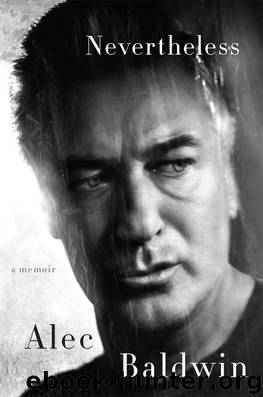
Author:Alec Baldwin [Baldwin, Alec]
Language: eng
Format: azw3
Publisher: HarperCollins
Published: 2017-04-04T04:00:00+00:00
9
What She Was Used To
Standing on a footbridge in Chicago on an April evening in 1991, the freezing temperature at a degree only Chicagoans could comprehend, I spoke with Michael Gruskoff, the producer of the film version of Prelude to a Kiss. “When is this thing scheduled to come out?” I asked. “Hopefully, by December,” he replied. “Good,” I said. “Because we’re going to win everything. Best picture, actor, actress, direction, screenplay.” The more seasoned Gruskoff managed a slight smile and said, “That would be nice.”
Adapting Prelude to the screen had proved to be difficult. Finding a cast that satisfied Norman and Craig as well as the Fox executives who had bought the rights was the first challenge. During that process, however, my next opportunity to meet a truly great actor materialized when Norman called me to say that Sir Alec Guinness was interested in the film and, pending the meeting, inclined to do it. I thought I might faint. Before long, I found myself seated across from Guinness at the old Wyndham Hotel in New York.
As had happened when I had met or worked with Pacino, De Niro, Tony Hopkins, Julie Andrews, George C. Scott, Meryl, Ava Gardner, McCartney, Gregory Peck, Tony Bennett, Brando, and the other artists whom I had admired, even worshipped, the sight and sound of Alec Guinness unleashed a torrent of his most famous cinematic accomplishments in my mind. Legendary movie moments began unspooling: The young Guinness in Great Expectations, admonishing John Mills not to “fill one’s mouth to its utmost capacity.” As Fagin in Oliver Twist (“What right have you to butcher me?”). His Academy Award–winning performance in The Bridge on the River Kwai. The Horse’s Mouth, Our Man in Havana, Lawrence of Arabia, Doctor Zhivago, Star Wars, and too many others to name. Alec Guinness, a totem in film acting, was now right before my eyes, making one simple request. “I’m afraid I must shoot the film in New York,” he stated quietly. “I must be able to Concorde back and forth to London to see my wife.” Norman had told me that Guinness’s wife was ill and that he needed to visit her periodically while shooting.
Quite quickly, however, my dream of costarring with Guinness disappeared as the Fox execs rode roughshod over Norman and Craig’s casting desires. Ultimately, to shoot the film in New York was too expensive, so Guinness had to withdraw. Naturally, Norman had wanted Mary-Louise to claim the role that was rightly hers, but Joe Roth, the head of Fox, and Roger Birnbaum, his second, protested. They insisted that Mary-Louise and I would need to be bolstered by a big name in the role of the old man, and strongly suggested Jack Lemmon or Art Carney. Norman told me he would rather not make the film if it meant hiring someone he did not see in the role. And then, in what reminded me of the Julie Andrews/My Fair Lady casting tale, Mary-Louise was gone and Meg Ryan was playing the lead.
Download
This site does not store any files on its server. We only index and link to content provided by other sites. Please contact the content providers to delete copyright contents if any and email us, we'll remove relevant links or contents immediately.
Cecilia; Or, Memoirs of an Heiress — Volume 2 by Fanny Burney(31928)
Cecilia; Or, Memoirs of an Heiress — Volume 3 by Fanny Burney(31914)
Fanny Burney by Claire Harman(26579)
We're Going to Need More Wine by Gabrielle Union(19020)
Plagued by Fire by Paul Hendrickson(17391)
All the Missing Girls by Megan Miranda(15884)
Cat's cradle by Kurt Vonnegut(15293)
Bombshells: Glamour Girls of a Lifetime by Sullivan Steve(14037)
For the Love of Europe by Rick Steves(13795)
Leonardo da Vinci by Walter Isaacson(13287)
4 3 2 1: A Novel by Paul Auster(12352)
The remains of the day by Kazuo Ishiguro(8944)
Adultolescence by Gabbie Hanna(8900)
Note to Self by Connor Franta(7655)
Diary of a Player by Brad Paisley(7537)
Giovanni's Room by James Baldwin(7297)
What Does This Button Do? by Bruce Dickinson(6185)
Ego Is the Enemy by Ryan Holiday(5389)
Born a Crime by Trevor Noah(5353)
